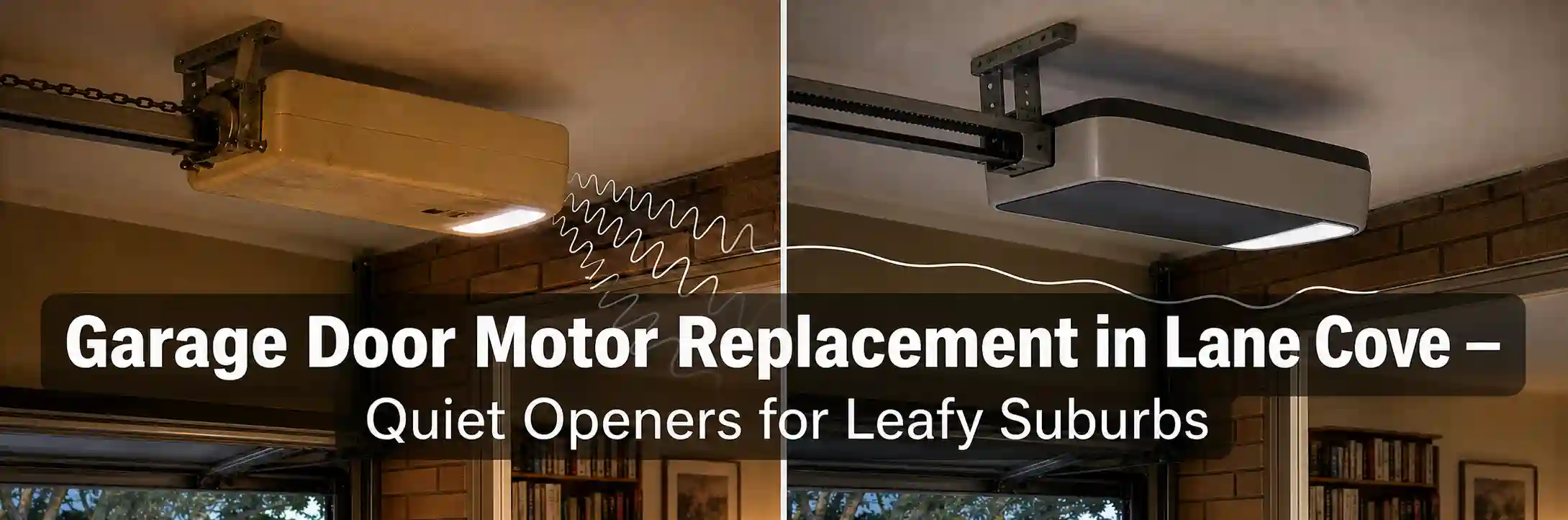
Garage door motor replacement in Lane Cove serves a suburb whose established residential character, river and national park surroundings, and long-tenure professional family community create specific motor specification requirements that distinguish the lower north shore from both the upper north shore’s hillside driveways and the inner western suburbs’ terrace configurations. Lane Cove’s post-war and 1960s brick homes on generous residential lots are predominantly single and double garage configurations with standard ceiling heights that accommodate both roller and sectional door systems.
The motor replacement need in Lane Cove is driven by the ageing of the 1990s chain-driven AC openers that were installed during the renovation wave that improved many of the suburb’s post-war homes — openers that are now 30 or more years old and that are reaching the end of their effective service life after three decades of Lane Cove’s river-adjacent humidity and Sydney’s seasonal temperature cycling.
Why Lane Cove motors are reaching replacement age now
Garage door motor replacement in Lane Cove reflects the same housing stock age dynamic that drives motor replacement in Carindale’s Brisbane east family homes and Canning Vale’s Perth southern homes — a wave of residential improvements made in the late 1980s and 1990s that installed chain-driven AC motors as standard and that are now producing a predictable wave of motor failures as those systems reach 30 to 35 years of age. A Lane Cove home that had its garage door automated in 1992 has a motor that has been in operation for over 30 years. In Lane Cove’s river-adjacent humidity environment, circuit board connections, motor windings, and drive gear plastics that have absorbed three decades of moisture have degraded faster than equivalent components in drier inland suburban environments.
The symptoms of an ageing Lane Cove garage door motor approaching replacement:
- Increasing operational noise — the chain-driven motor that was acceptably quiet in 1995 has progressively louder operation as the drive chain stretches and the sprocket teeth wear. In Lane Cove’s established residential streets where homes are closer together than in outer suburban developments, a loud chain-driven motor is an audible neighbour nuisance in addition to a household noise problem.
- Intermittent failure — a motor whose circuit board has degraded connections from Lane Cove’s humidity and age may fail intermittently, particularly in wet weather when elevated humidity pushes the board’s marginal connections past their operating threshold.
- Slow operation — a motor whose drive gear is beginning to strip produces a door that moves noticeably slower than it did when new, with the motor audibly working harder than the door’s weight requires.
Quiet motor specification for Lane Cove’s leafy suburb character
Garage door motor replacement in Lane Cove has a specific quiet operation priority that reflects the suburb’s established residential character. Lane Cove’s residential streets are quieter than many Sydney suburbs — the national park adjacency, the river foreshore, and the generous street tree canopy create an ambient sound environment where the noise of an ageing chain-driven motor is more noticeable and more disruptive than in a busier suburban environment.
For Lane Cove’s attached garages, where the motor noise travels through the shared wall into adjacent living areas, the motor replacement is an opportunity to address a noise problem that may have been tolerated for years alongside the operational decline of the ageing motor.
- Belt-driven DC motor for attached garages — the belt-driven DC motor eliminates the chain rattle that is the primary noise source in 1990s chain-driven systems and provides the soft-start and soft-stop cycles that reduce mechanical impact noise. For a Lane Cove attached garage adjacent to a study, living room, or bedroom, a belt-driven DC motor operating at 65 decibels is not a disturbance in the suburb’s quiet residential environment.
- Tubular motor for roller door replacements — for Lane Cove homes with roller doors, a tubular motor inside the drum is the quietest available residential automation option. The drum housing absorbs the motor’s operating sound, and the absence of a drive rail eliminates ceiling-transmitted vibration. For a Lane Cove home whose garage is beneath a living area or adjacent to a quiet study, the tubular motor’s noise isolation is the specific advantage that makes it the appropriate choice.
Humidity rating for Lane Cove river-adjacent garages
Garage door motor replacement in Lane Cove for homes in the river-adjacent streets — particularly those closest to the Lane Cove River foreshore and the national park boundary — should specify a motor whose housing is rated for the elevated humidity that the river and bushland moisture environment creates. The IP rating of the motor housing determines its protection against moisture ingress:
- IP55 minimum for Lane Cove river-adjacent garages — an IP55 rating confirms protection against dust ingress and water jets from any direction. For a Lane Cove garage in one of the foreshore streets where the ambient humidity is elevated year-round from the river, IP55 is the minimum appropriate motor specification.
- Corrosion-resistant mounting hardware — the mounting brackets and any ceiling hardware for the motor installation should be stainless steel or hot-dipped galvanised. In Lane Cove’s river-adjacent humidity, standard zinc-plated hardware develops surface rust within a few years in the most humidity-exposed locations.
Smart connectivity for Lane Cove professional families
Garage door motor replacement in Lane Cove is the natural upgrade point for adding smart connectivity to a home whose original 1990s chain-driven opener had no connectivity beyond a single-frequency remote control. Lane Cove’s professional family community — the suburb attracts Sydney professionals who value the lower north shore lifestyle, the national park access, and the proximity to the CBD via the Pacific Highway and Longueville Road corridors — is exactly the demographic that uses smart opener features as daily household management tools:
- Real-time status from the office — a Lane Cove professional commuting to the CBD on the Pacific Highway who cannot remember whether the garage closed can check the app in seconds. The Lane Cove commuter who uses this feature daily values it as much as the Hornsby train commuter or the Carindale Brisbane professional.
- Auto-close for river-adjacent security — a Lane Cove garage left open adjacent to the national park foreshore walking tracks has a specific security exposure from the public access those tracks provide. The auto-close timer that ensures the door closes within a set period of the last use addresses this specific Lane Cove security dimension.
- Battery backup for storm outages — Sydney’s lower north shore experiences power outages during severe storm events, particularly when storms affect the tree canopy that characterises Lane Cove’s national park-adjacent streets. A motor with battery backup allows the garage door to operate through a power outage.
The lower north shore’s proximity to the Sydney CBD — Lane Cove is 9 kilometres from the CBD via the Pacific Highway and Gore Hill Freeway — means the suburb’s professional families have short-commute access to the city’s employment centres. This proximity produces household routines where the garage door is operated at the beginning and end of relatively short daily commutes, and where the reliability of the morning garage operation matters as much as in the more extreme commuter suburb of Hornsby but without the train-catching urgency that makes a Hornsby spring failure a transport emergency.
A Lane Cove motor replacement that produces a reliable, quiet, smart-connected opener is one that fits seamlessly into the daily rhythm of a household that values the lower north shore lifestyle’s combination of proximity to the CBD and quality of suburban environment — and that does not introduce the noise, unreliability, or security concerns that an ageing chain-driven motor has accumulated over its 30 years of service.
The strata dimension of motor replacement in Lane Cove is relevant for the suburb’s townhouse and unit developments, which make up a portion of the housing stock alongside the predominantly freestanding family homes. For Lane Cove strata properties where the garage is common property, the owners corporation’s approval is required before any motor replacement on a common property garage door is commissioned.
The NSW Strata Schemes Management Act 2015 governs this, and the strata manager’s advice on the approval requirement for a specific Lane Cove strata property is the first step before any motor replacement is booked. For Lane Cove strata lot owners whose garage door is within their lot entitlement rather than common property, the motor replacement proceeds as for any freestanding property, with confirmation from the strata manager that the door is indeed lot property before work commences.
Conclusion
Garage door motor replacement in Lane Cove requires a specification that addresses the specific dimensions of this lower north shore suburb: a belt-driven DC or tubular motor for the quiet operation appropriate to Lane Cove’s established residential character, an IP55 or higher humidity rating for river-adjacent garages, stainless or galvanised mounting hardware for the foreshore moisture environment, smart connectivity for the suburb’s professional family demographic, and battery backup for storm event reliability.
A lower north shore-experienced installer who understands Lane Cove’s specific combination of heritage considerations, river-adjacent humidity, and professional household expectations delivers a motor replacement that serves this suburb at the standard its established community deserves.