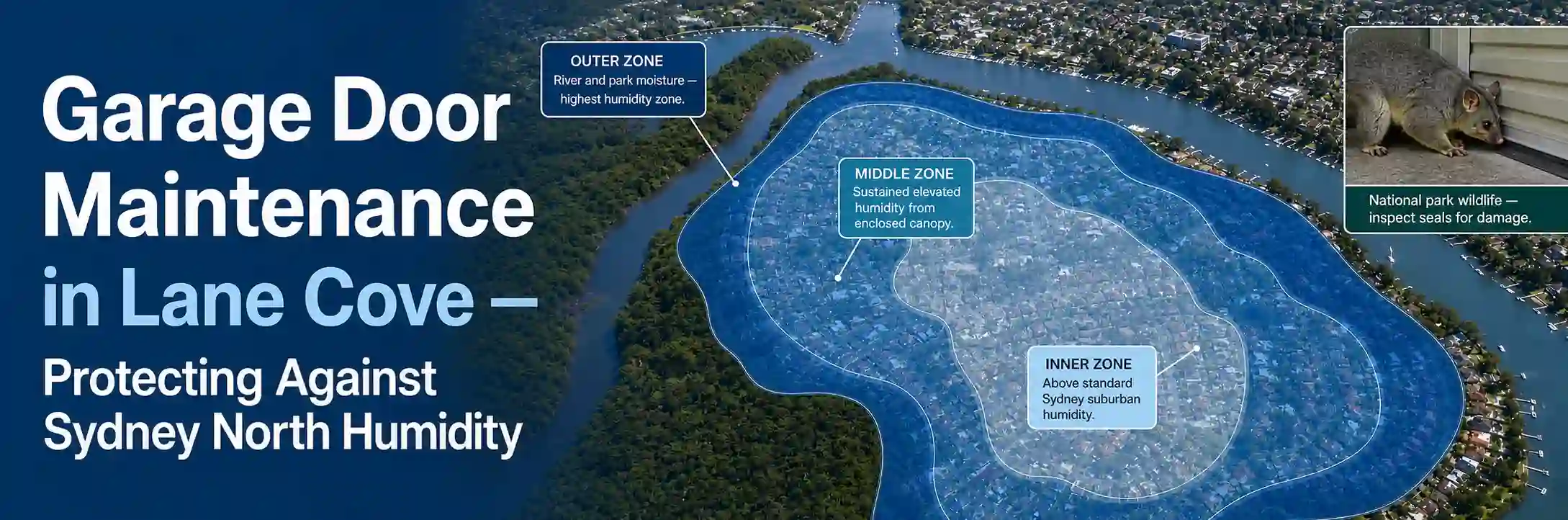
Garage door maintenance in Lane Cove is shaped by an environmental dimension that distinguishes this lower north shore suburb from both the upper north shore’s Hornsby with its winter condensation, and the inner western suburbs with their standard Sydney seasonal humidity. Lane Cove occupies a river peninsula — the suburb is bounded by the Lane Cove River on three sides and by the Lane Cove National Park that adjoins its western and southern boundaries.
The combination of river moisture from 16 kilometres of foreshore, evaporation from the national park vegetation and the river surface, and the enclosed microclimate that the peninsula’s tree canopy creates produces a year-round elevated ambient humidity in Lane Cove’s residential streets that is specific to the suburb’s river-peninsula geography. Garage door maintenance in Lane Cove calibrated to this specific humidity environment is the programme that prevents the accelerated corrosion that the river and national park moisture creates in garage door metal components that are not properly protected.
How Lane Cove’s river and national park create a humidity microenvironment
Garage door maintenance in Lane Cove begins with understanding why the suburb’s geography creates a specific humidity dimension for garage door components. The Lane Cove River foreshore is not a distant landmark for most Lane Cove properties — it is an intimate presence in the suburb’s street network, with many residential streets running directly to the river foreshore reserve and the national park walking tracks.
The river surface evaporates moisture continuously, and the national park vegetation on the riverbanks holds moisture from rainfall and dew for longer than cleared land would, sustaining the elevated ambient humidity through periods of dry weather that would reduce the humidity in more exposed suburban locations.
The tree canopy that covers Lane Cove’s residential streets — the established street trees, the garden plantings, and the national park vegetation — reduces wind movement that would otherwise dilute the river-generated humidity. The result is a residential microenvironment in Lane Cove’s foreshore streets where the ambient humidity is consistently higher than in Lane Cove’s more elevated streets away from the river, and specifically higher than in comparable Sydney suburbs on flat terrain without river or bushland adjacency.
The humidity effect on Lane Cove garage door components
Garage door maintenance in Lane Cove addresses the specific failure modes that the river-peninsula humidity creates:
- Spring surface rust in foreshore streets — springs in garages adjacent to the Lane Cove River foreshore and the national park develop surface rust from the moisture environment at a rate that is above the standard Sydney suburban average. A spring in one of the foreshore streets that has never been lubricated with a corrosion-inhibiting product may develop visible surface rust within two to three years of installation in the most humidity-exposed locations.
- Cable end fitting corrosion — the internal corrosion that begins at cable end fittings in high-humidity environments — rust developing on the cable strands inside the fitting housing where they are least accessible for inspection — occurs faster in Lane Cove’s river-adjacent humidity than in equivalent garages in drier Sydney suburbs. Cable inspection at every maintenance visit should specifically use a torch to check for rust staining emerging from inside the fitting housing.
- Opener board moisture ingress — moisture from the river-adjacent atmosphere can enter an opener motor housing that has any unsealed gap — an unsealed cable entry, a worn housing gasket, or an unrated housing for the humidity exposure level. The condensation that forms on cold surfaces inside an unsealed housing creates the board corrosion that produces intermittent and eventually permanent motor failure.
- Organic debris from national park — Lane Cove garages adjacent to the national park boundary receive organic debris from the park vegetation — leaves, bark, seed pods, and spider nests — at a rate that exceeds standard suburban debris accumulation. Guide rail channels in national park-adjacent garages accumulate organic material that combines with humidity to create a moist, corrosion-promoting environment inside the rail.
The Lane Cove maintenance calendar
Garage door maintenance in Lane Cove is most effectively structured around Sydney’s seasons, with specific attention to the periods of highest and lowest humidity:
April-May — post-summer service: The autumn service following summer cleans summer’s accumulated debris and degraded lubricant from guide rails, inspects springs for any rust development, and applies fresh corrosion-inhibiting lubricant to all metal components before the cooler, wetter months begin. For Lane Cove foreshore-adjacent properties, this post-summer visit also addresses the organic debris that accumulated from the national park vegetation during summer.
October — pre-summer preparation: The spring service applies fresh lubricant before summer and confirms that the motor housing is sealed against the elevated humidity that summer rainfall and humidity creates. Any seals that are cracking or hardening are replaced before summer.
For foreshore-adjacent properties: A mid-year inspection in June or July for properties in the streets closest to the Lane Cove River foreshore is appropriate. The winter period, when rainfall is higher and the river humidity is sustained, is the period of highest humidity-driven corrosion risk for the most exposed properties in the suburb.
The complete Lane Cove maintenance checklist
Garage door maintenance in Lane Cove covers all components with specific attention to humidity-driven failure modes:
- Spring inspection — humidity focus: Inspect spring coils with a torch specifically for surface rust. In Lane Cove’s river-adjacent environment, any rust on a spring warrants treatment with a moisture-displacing corrosion-inhibiting lubricant applied to the full spring length. A dry PTFE lubricant provides good dust resistance but does not provide the active moisture-displacing protection that Lane Cove’s humidity requires — the lubricant selection should specify moisture-displacing properties for this environment.
- Cable end fitting inspection: Both end fittings should be inspected with a torch for any rust staining emerging from inside the fitting. Any staining indicates internal cable strand corrosion that warrants replacement before the next maintenance visit.
- Guide rail cleaning — national park debris: Clean guide rails thoroughly before lubricating, with specific attention to organic debris — leaf fragments, spider webs, bark particles — that accumulates in national park-adjacent garages. A stiff brush and dry cloth before any lubricant is applied.
- Sensor lens clearance: Spider webs are the most common sensor fault cause in Lane Cove’s national park-adjacent garages. Both sensor lenses should be cleaned with a dry cloth at every maintenance visit, and the area around the sensor housing should be checked for web-building activity.
- Opener housing moisture check: Inspect the opener motor housing for any condensation marks or moisture staining. Unsealed cable entry points should be sealed with silicone before the wet season.
- Bottom seal inspection: The bottom seal should be inspected for cracking or hardening. Seals on Lane Cove homes adjacent to the national park may also be inspected for any damage from wildlife — the possums, birds, and occasional reptiles of the national park area are known to investigate garage door seals.
The Lane Cove National Park, which immediately adjoins the suburb’s western and southern boundaries, introduces a specific wildlife dimension to garage door maintenance in the foreshore-adjacent streets. Possums, which are abundant in the national park and throughout Lane Cove’s residential streets, are known to investigate garage door seals and bottom rails as nesting or sheltering sites. A bottom seal that has been damaged by possum activity — with teeth marks or torn rubber sections — is one that no longer seals effectively against moisture entry or organic debris.
The maintenance visit for Lane Cove homes adjacent to the national park should specifically include inspection of the bottom seal for wildlife-related damage alongside the standard deterioration from UV and humidity exposure. A seal with any evidence of wildlife damage should be replaced regardless of its age or its apparent condition in the undamaged sections.
The Sydney Trains network’s connections near Lane Cove — the suburb is served by bus connections to the St Leonards and Chatswood rail corridors on the T1 North Shore Line — mean that many Lane Cove households have at least one daily commuter whose garage door operation is part of the departure and return routine. A garage door that operates reliably and quietly for the morning and evening commuter is one whose maintenance has kept it in the condition that routine daily use demands. For Lane Cove households where the daily commute involves a specific bus or train connection with limited departure window tolerance, a garage door that sticks on a cold July morning or that takes three attempts to close on a humid autumn evening is a daily friction point that the annual maintenance programme prevents.
The maintenance investment that keeps a Lane Cove garage door operating smoothly through Sydney’s full seasonal cycle is proportionate to the daily value that reliable garage door operation provides to a household whose daily routine depends on it.
Conclusion
Garage door maintenance in Lane Cove is calibrated to the river-peninsula humidity environment that makes this lower north shore suburb’s maintenance requirements more specific than standard Sydney suburban maintenance. The spring rust risk from the Lane Cove River foreshore moisture, the cable end fitting corrosion that begins internally in high-humidity conditions, the organic debris from the national park vegetation, and the sensor spider web risk in the national park-adjacent streets all define the specific maintenance approach that protects Lane Cove garage door systems through Sydney’s full seasonal cycle.
A maintenance provider who understands the Lane Cove River’s specific humidity influence — and who specifies moisture-displacing lubricant, inspects cable end fittings with a torch, and clears sensor lenses from spider web activity at every visit — delivers maintenance that genuinely protects lower north shore homes in one of Sydney’s most environmentally distinctive suburbs.