
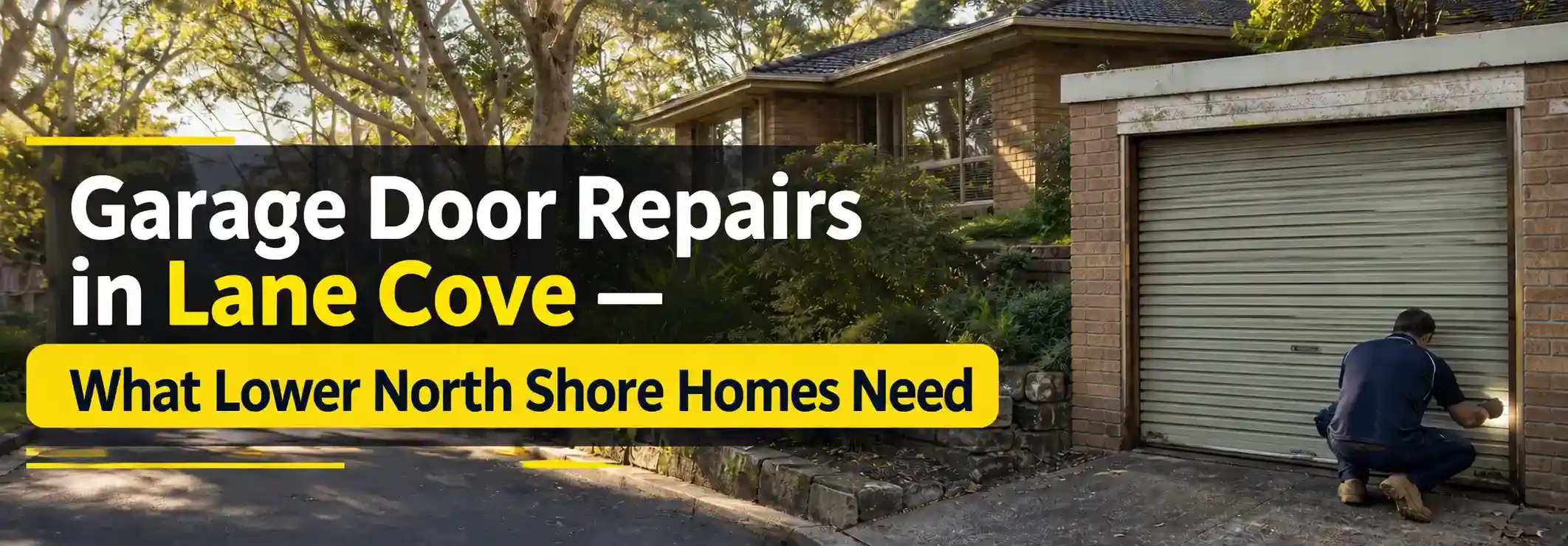
Garage door repairs in Lane Cove address one of Sydney’s most established and most desirable lower north shore suburbs. Lane Cove sits on a peninsula 9 kilometres north-west of the Sydney CBD, bounded by the Lane Cove River and surrounded by the Lane Cove National Park that defines the suburb’s distinctive leafy character. The Lane Cove Municipal Council administers one of metropolitan Sydney’s most compact local government areas — 10.5 square kilometres with 16 kilometres of river foreshore, much of it in public ownership — whose established residential character is reflected in an extraordinary 45% outright property ownership rate that speaks to the long-tenure, invested families who have made Lane Cove their home for decades.
Garage door repairs in Lane Cove operate within this specific combination of established housing stock, Lane Cove Council’s Heritage Conservation Areas planning framework, the river and national park moisture environment, and the expectations of a community whose median property values reflect the premium character of the lower north shore.
Lane Cove’s housing stock and garage door profile
The residential streets of Lane Cove are predominantly post-war housing stock — brick homes built from the late 1940s through the 1970s that replaced the pre-war dwellings of the suburb’s earlier development period, alongside Federation-era homes on the suburb’s most significant streets that are now heritage-listed or within Heritage Conservation Areas under the Lane Cove Local Environmental Plan. These established homes have garage configurations that reflect their era: single-car garages with standard residential openings in the post-war stock, original tilt doors or early roller door installations that have been in service for 30 to 50 years in many cases, and the occasional double garage in larger homes on wider lots.
The 45% outright ownership rate tells a specific story about Lane Cove’s garage door repair landscape: the households who own their homes without a mortgage have typically been in the same property for many years, and their garage door systems reflect the accumulated service life of that tenure. A Lane Cove family who moved into their post-war brick home in the late 1980s and has owned it outright for the past decade may have a garage door system that is approaching or exceeding 35 years of operation in the river-adjacent moisture environment that Lane Cove’s peninsula character creates.
The Lane Cove River and National Park humidity environment
Garage door repairs in Lane Cove are shaped by a specific environmental dimension that Hornsby’s upper north shore context does not create to the same degree: the moisture environment of a river peninsula surrounded by national park. The Lane Cove River foreshore, the extensive public parkland reserves that border the suburb, and the Lane Cove National Park that adjoins the suburb’s western and southern boundaries create a year-round elevated humidity environment that is distinct from both the coastal salt air of Sydney’s harbour suburbs and the inland humidity of Brisbane’s subtropical climate.
The moisture that evaporates from the river, from the national park vegetation, and from the extensive native bushland that characterises Lane Cove’s public reserves creates a persistently humid microenvironment in the suburb’s residential streets — particularly in the lower-lying streets that run toward the river foreshore. Garage door springs, cables, and guide rail hardware in homes on the streets closest to the Lane Cove River foreshore are in a more corrosion-promoting environment than equivalent hardware in the suburb’s more elevated streets away from the river.
Common repair needs in established Lane Cove homes
Garage door repairs in Lane Cove for the suburb’s established housing stock reflect specific age and environment factors:
- Tilt door mechanism failures in post-war homes — the original tilt doors in Lane Cove’s post-war brick homes have pivot hardware, counterbalance springs, and panel hinges that have been in service for decades in the river-adjacent humidity environment. Springs in these older tilt door systems that have never been lubricated with a corrosion-inhibiting product develop surface rust from the moisture environment at a rate that shortens their service life below what the cycle count alone would predict.
- Spring failures in ageing systems — springs in Lane Cove homes adjacent to the river foreshore and the national park accumulate corrosion from the elevated ambient moisture at a rate above the standard suburban Sydney average. Annual lubrication with a moisture-displacing corrosion inhibitor is more important in Lane Cove’s river-adjacent streets than in Sydney’s drier inland suburbs.
- Motor deterioration in long-tenure homes — the automatic openers in Lane Cove’s established homes include ageing chain-driven systems from the 1990s that have now been in service for 30 years. Drive gear wear, circuit board degradation, and humidity-affected connections produce the intermittent and eventually complete failure that generates repair calls.
- Heritage-sensitive repairs — for homes within Lane Cove’s Heritage Conservation Areas or on heritage-listed properties, the repair approach must be sensitive to the property’s heritage significance, as described in the heritage blog.
Lane Cove Municipal Council and garage door repairs
Garage door repairs in Lane Cove under Lane Cove Municipal Council’s planning framework follow the NSW Environmental Planning and Assessment Act 1979 and the Lane Cove Local Environmental Plan 2009. Standard mechanical repairs — spring replacement, cable repair, motor service — do not require development approval under Lane Cove Council’s planning framework. Like-for-like repairs that replace a failed component with an equivalent specification without changing the door’s external appearance proceed without planning assessment.
For properties within Lane Cove’s Heritage Conservation Areas or on individual heritage items listed in the Lane Cove LEP 2009 Schedule 5, any repair that changes the door’s visible appearance — even a like-for-like replacement with a cosmetically different product — should be assessed against the heritage provisions before proceeding. Lane Cove Council’s heritage advisor can provide guidance on specific heritage properties.
Choosing a Lane Cove garage door repair technician
Garage door repairs in Lane Cove are best served by a technician who regularly works across the lower north shore corridor and who understands the Lane Cove Council planning framework, the river and national park humidity dimension, and the specific housing types of Lane Cove’s established residential streets. A lower north shore-based technician reaches Lane Cove efficiently from the Pacific Highway corridor and is familiar with the post-war housing stock and the specific access configurations of the suburb’s residential streets.
Lane Cove’s community character — the Lane Cove village commercial area on Longueville Road, the national park walking tracks that connect the suburb’s residential streets to the river foreshore, the family-friendly parks and the established school network — reflects a suburb that has invested in its residential quality for decades. The long-tenure families who own their Lane Cove homes outright are not passive inhabitants but active participants in the suburb’s maintenance standards, and their expectation of the trade services that work on their properties reflects this investment.
A garage door repair technician who understands Lane Cove’s specific conditions — the river humidity, the national park adjacency, the heritage planning framework, the established housing stock — and who brings this knowledge to the assessment and repair is one who serves the Lane Cove community at the standard its invested families deserve. The repair visit that begins with a full system condition assessment rather than a direct jump to the presenting fault, that notes the humidity-driven rust on springs adjacent to the river foreshore, and that provides a written record of what was observed and what was done is the visit that earns the recommendation that moves through Lane Cove’s close-knit residential community.
The NSW planning framework that applies to Lane Cove through the Lane Cove LEP 2009 and the State Environmental Planning Policy (Exempt and Complying Development Codes) 2008 provides the regulatory context for understanding which garage door works require development approval and which can proceed as exempt development. For the vast majority of repair work in Lane Cove — spring replacements, motor repairs, cable service — the exempt development provisions allow the work to proceed without any planning interaction with Lane Cove Council.
The heritage dimension that requires careful planning consideration applies to the much smaller proportion of works that involve a change to the external appearance of a heritage-listed or conservation area property, and even there, the pre-lodgement meeting with Lane Cove Council is a brief and productive interaction that most commonly results in clear guidance rather than a prolonged assessment process. The combination of NSW’s streamlined exempt development provisions and Lane Cove Council’s heritage advisory support means that most Lane Cove garage door repair decisions are made by the homeowner and their technician without any council involvement, and the minority that benefit from council guidance are generally resolved efficiently when the homeowner engages early and in good faith.
Conclusion
Garage door repairs in Lane Cove serve one of Sydney’s most established lower north shore suburbs — a peninsula community whose river and national park surroundings, 45% outright ownership rate, and long-tenure housing stock create a specific repair environment. The river-adjacent humidity that shortens spring and cable service life in streets near the foreshore, the ageing tilt door and early roller door systems in post-war homes with decades of service behind them, and the heritage sensitivity required for repairs on conservation area and heritage-listed properties all define the repair context that a lower north shore experienced technician navigates correctly.