
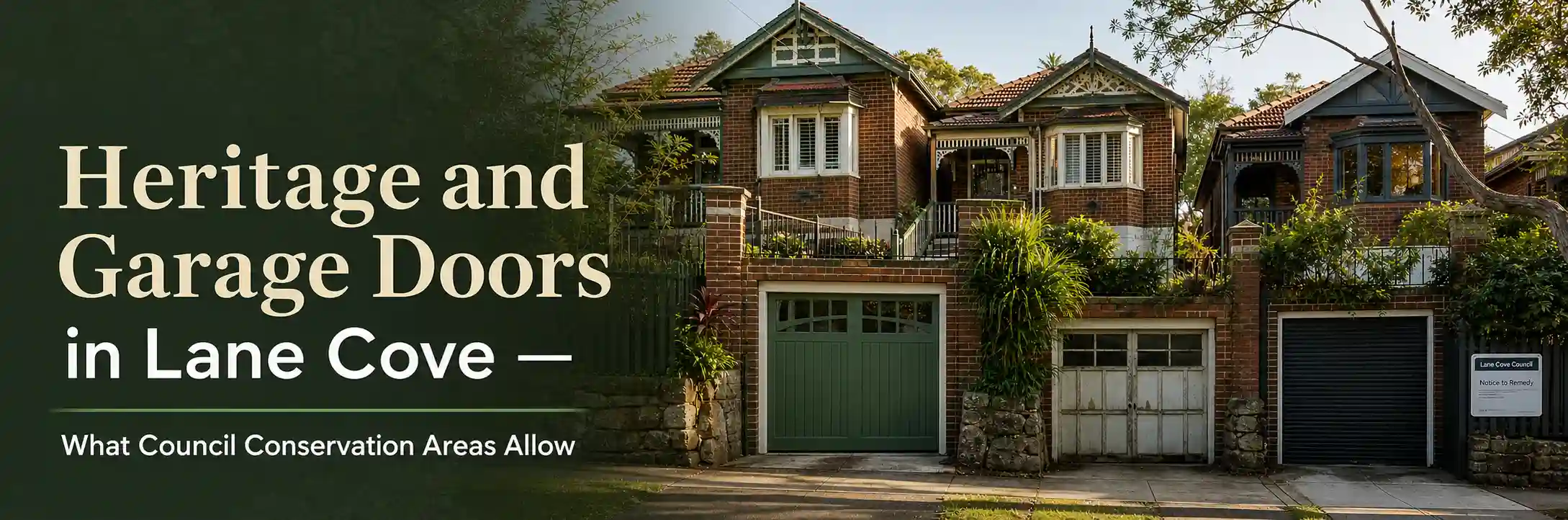
Heritage and garage doors in Lane Cove is the planning topic that any Lane Cove homeowner with a heritage-listed property or a property within one of Lane Cove Council’s Heritage Conservation Areas must understand before making any decision about their garage door that goes beyond a straight like-for-like repair. Lane Cove Municipal Council has undertaken two formal heritage review stages — Stage 1 in 2006 and Stage 2 in 2009 — that identified the heritage significance of the suburb’s residential streetscapes and individual properties.
The Lane Cove Local Environmental Plan 2009 gives effect to these reviews through Schedule 5 heritage listings and Heritage Conservation Area provisions that govern what is acceptable for the external appearance of heritage-significant properties in the Lane Cove LGA. Heritage and garage doors in Lane Cove addresses this specific planning framework — what it requires, how it applies to garage door decisions, and what the process is when a change is proposed.
Lane Cove’s heritage framework under the LEP 2009
Heritage and garage doors in Lane Cove operates under the Lane Cove Local Environmental Plan 2009, which contains two levels of heritage protection relevant to garage door decisions:
Individual heritage items in Schedule 5: Properties individually listed in Schedule 5 of the Lane Cove LEP 2009 have the highest level of heritage protection in the LGA. Individual heritage listings in Lane Cove include Federation-era homes, interwar bungalows, and post-war properties of local significance. For a heritage-listed Lane Cove property, any work that affects the heritage significance of the item — including any change to the external appearance of the garage door visible from the street or from a public place — requires a development application to Lane Cove Council assessed against the heritage provisions of the LEP 2009 and the Heritage Conservation Development Control Plan.
Heritage Conservation Areas: Lane Cove Council’s Conservation Areas Study, commissioned as Stage 1 of the heritage review in 2006, identified areas of Lane Cove whose collective streetscape character has heritage significance. Properties within these Heritage Conservation Areas are subject to provisions that protect the character of the streetscape, even where the individual property is not a heritage item in its own right. For a Lane Cove property within a Heritage Conservation Area, any work that changes the external appearance and is visible from the street is assessable under the Heritage Conservation Area provisions.
What requires a development application in Lane Cove
Heritage and garage doors in Lane Cove: the development application requirement depends on the specific heritage status of the property and the nature of the proposed work:
No DA required — like-for-like repairs: Spring replacement, cable replacement, motor repair, guide rail service, and any mechanical maintenance that does not change the external appearance of the door proceed without development approval for all Lane Cove properties, including heritage-listed and conservation area properties. The heritage protection applies to changes to the appearance of the heritage fabric, not to maintenance that preserves the existing appearance.
DA required — heritage-listed properties: Any change to the external appearance of the garage door on a Schedule 5 heritage-listed Lane Cove property requires a development application. This includes replacing a timber door with a steel alternative, changing the door profile, changing the door colour to one outside the heritage palette of the property, installing an automated motor where no motor previously existed if the motor hardware is visible from the street, or widening the garage opening.
Assessable — Heritage Conservation Area properties: For properties within a Heritage Conservation Area that are not individually heritage-listed, Lane Cove Council’s assessment of whether a development application is required for a garage door change depends on whether the proposed change is consistent with the character of the conservation area. A like-for-like replacement that maintains the existing appearance is generally exempt; a change that introduces materials, colours, or profiles inconsistent with the conservation area’s character is assessable.
Heritage-appropriate garage door options for Lane Cove
Heritage and garage doors in Lane Cove for properties where the heritage assessment supports or requires a character-appropriate installation:
- Timber panel doors for Federation and interwar homes — the most character-authentic option for Lane Cove’s Federation-era and interwar properties. A timber panelled door in a period-appropriate profile and heritage colour relates directly to the original timber garage door character of these homes. In Lane Cove’s river-adjacent humidity environment, timber doors require a specific maintenance programme — regular inspection of the paint or stain coating and proactive recoating before the coating fails — to prevent moisture ingress that causes premature timber deterioration.
- Steel in heritage profiles and colours — for Lane Cove properties where a timber door is not required by the heritage assessment but where the character area provisions require a character-compatible installation, a steel sectional door in a simple raised panel or coach house profile with a heritage palette colour provides a durable, lower-maintenance alternative to timber that can be assessed as character-compatible in many Lane Cove Conservation Area contexts.
- Roller doors in heritage colours for less prominent openings — for garage openings that are not prominently visible from the street, or where the existing door is a roller door and a like-for-like roller door replacement is proposed, a roller door in a heritage palette colour may be an acceptable conservation area replacement. Confirming acceptability with Lane Cove Council’s development assessment team before ordering is the step that prevents a non-compliant installation.
The Lane Cove Council heritage application process
Heritage and garage doors in Lane Cove where a development application is required follows Lane Cove Council’s development assessment process under the Lane Cove LEP 2009 and associated Development Control Plans. The preparation for a heritage garage door DA to Lane Cove Council should include:
- Confirm the property’s heritage status — is it a Schedule 5 individual heritage item, within a Heritage Conservation Area, or both? Lane Cove Council’s GIS mapping tool allows property heritage status to be confirmed online before any application is prepared.
- Arrange a pre-lodgement meeting with Lane Cove Council’s development assessment team and, if available, the Council’s heritage advisor. A pre-lodgement meeting before any product is selected confirms what the heritage assessment requires and what products are most likely to receive support.
- Prepare a Statement of Heritage Impact addressing how the proposed garage door change affects the heritage significance of the property and its contribution to the Conservation Area character, in accordance with the NSW Heritage Office guidelines.
- Include documentation of the proposed door — material, profile, colour, and dimensions — and photographs of the existing garage in its streetscape context.
Heritage humility and Lane Cove’s community
Heritage and garage doors in Lane Cove reflects a community that values the character of its established residential streetscapes. Lane Cove’s long-tenure owner-occupier community — with its 45% outright ownership rate and its decades of investment in the suburb’s leafy character — is a community that generally shares the values that heritage conservation protects. The homeowner who engages the heritage assessment process with a genuine desire to understand what is appropriate for their specific property, rather than looking for the minimum compliance path, is one who contributes to the continuation of the streetscape character that makes Lane Cove one of Sydney’s most desirable lower north shore addresses.
The NSW Heritage Division’s online heritage database — hms.heritage.nsw.gov.au — is the starting point for any Lane Cove homeowner who wants to confirm whether their property is on the State Heritage Register in addition to any Lane Cove Council LEP listing. Properties on the State Heritage Register have a higher level of protection than those on the Local Environmental Plan alone, and the assessment process for State Heritage Register properties involves referral to the NSW Heritage Division alongside the Lane Cove Council DA assessment.
For Lane Cove homes in the suburb’s most significant heritage streets — those closest to the foreshore where the Federation-era development that first established the suburb’s character is concentrated — checking the State Heritage Register before assuming that Lane Cove Council is the only relevant authority is the due diligence step that confirms the full heritage protection framework applicable to the specific property.
Conclusion
Heritage and garage doors in Lane Cove is a topic that requires understanding Lane Cove Council’s two-tier heritage framework — individual heritage items in Schedule 5 of the LEP 2009 and Heritage Conservation Areas from the 2006 Conservation Areas Study — and applying the correct assessment pathway for the specific property.
Like-for-like repairs never require a DA. Changes to the external appearance of a heritage-listed or conservation area property require either DA assessment or pre-lodgement confirmation of exempt development status. Engaging Lane Cove Council’s development assessment team before any product is ordered, and using the pre-lodgement meeting to confirm what is acceptable, is the process that produces a correct and compliant heritage garage door outcome in one of Sydney’s most heritage-conscious lower north shore communities.